

Flood Insurance Manual: Difference between revisions
No edit summary |
No edit summary |
||
| Line 7: | Line 7: | ||
The FIM is organized into sections and appendices. '''Sections''' address key topics such as eligibility, rating, and policy changes. '''Appendices''' provide supporting details like forms and reference tables. | The FIM is organized into sections and appendices. '''Sections''' address key topics such as eligibility, rating, and policy changes. '''Appendices''' provide supporting details like forms and reference tables. | ||
The FIM outlines the '''operational processes''' used to manage NFIP policies. These include tasks like updating policy details, processing renewals, and handling cancellations. | |||
The FIM | The FIM provides '''detailed technical guidance''' to ensure accuracy in NFIP policy management. This includes information like how premiums are calculated, how flood zones are determined, and the specific documentation required. | ||
The ''Flood Insurance Manual'' is your go-to resource for understanding and managing NFIP policies. Updated regularly, usually once a year, it ensures the most current guidelines are available. | |||
The {{FIM}} combines big-picture concepts, step-by-step processes, and detailed technical information. You will become more familiar with it as you progress through the underwriter curriculum. | |||
{{nfip}} | {{nfip}} | ||
Revision as of 14:13, 3 December 2024

The NFIP Flood Insurance Manual (FIM) is a comprehensive guide for underwriting and managing policies. It outlines rules, procedures, and technical details. You should view it as a primary resource, designed to ensure accuracy and compliance in flood insurance operations.
Although the FIM is highly organized, sections can blend high-level concepts, operational processes, and technical details fluidly, which can be confusing to non-experts. You will explore the FIM with this in mind.
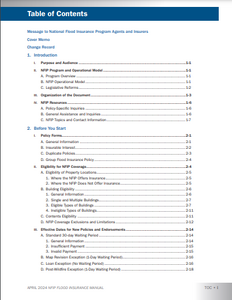
The FIM is organized into sections and appendices. Sections address key topics such as eligibility, rating, and policy changes. Appendices provide supporting details like forms and reference tables.
The FIM outlines the operational processes used to manage NFIP policies. These include tasks like updating policy details, processing renewals, and handling cancellations.
The FIM provides detailed technical guidance to ensure accuracy in NFIP policy management. This includes information like how premiums are calculated, how flood zones are determined, and the specific documentation required.
The Flood Insurance Manual is your go-to resource for understanding and managing NFIP policies. Updated regularly, usually once a year, it ensures the most current guidelines are available.
The FIM combines big-picture concepts, step-by-step processes, and detailed technical information. You will become more familiar with it as you progress through the underwriter curriculum.