

Create NFIP Application: Difference between revisions
No edit summary |
No edit summary |
||
| Line 114: | Line 114: | ||
|title = [[File:Icon-info-grey.png|20px|link=]] Number of Floors | |title = [[File:Icon-info-grey.png|20px|link=]] Number of Floors | ||
|content = | |content = | ||
Determine the building's number of floors based on the number of floors above the ground, excluding enclosures, crawl spaces which are both on grade or subgrade basements, and certain attics if only used for storage. For example: | |||
* A building with a basement and one floor above ground is rated as having one floor. | |||
* An elevated building with an enclosure either compliant or non-compliant and one additional floor above it is rated as having one floor. | |||
Indicate the total number of floors in a multi-unit building, even if the policy will cover only an individual unit. | |||
}} | |||
{{collapsible-details | |||
|number = 43 | |||
|title = [[File:Icon-info-grey.png|20px|link=]] Square Footage | |||
|content = | |||
For a single-family home, a residential manufactured mobile home, a residential unit, or two- to four-family building, provide the total finished living area. Do not include: | |||
* Garage area | |||
* Basement or enclosure area | |||
* Porches or decks | |||
For other types of buildings, include the square footage of stairwells and elevator shafts but exclude basements or mezzanines. If all floors are the same size, calculate the floor area first, then compute the gross floor area by multiplying the ground floor area by the number of floors. | |||
}} | |||
{{collapsible-details | |||
|number = 44 | |||
|title = [[File:Icon-info-grey.png|20px|link=]] Building Replacement Cost Value | |||
|content = | |||
The building replacement cost is the cost to replace the building or unit, including the cost of the foundation for a building, not for a unit. The building replacement cost used for rating has no bearing on the amount of coverage the policyholder can select. If you do not agree with the replacement cost provided, update it accordingly. Supporting documentation requirements vary based on the type of building and its size, and the replacement cost must be validated every three years. | |||
}} | |||
{{collapsible-details | |||
|number = 45 | |||
|title = [[File:Icon-info-grey.png|20px|link=]] Substantial Improvement Date | |||
|content = | |||
A substantially improved building is a building that has undergone reconstruction, rehabilitation, addition, or other improvement, the cost of which equals or exceeds 50% (or a lower threshold if adopted and enforced by the community) of the market value of the building for the start of construction. This does not include: | |||
* Improvements to correct code violations | |||
* Alterations to historic buildings that preserve their designation | |||
}} | |||
{{collapsible-details | |||
|number = 46 | |||
|title = [[File:Icon-info-grey.png|20px|link=]] Construction Type | |||
|content = | |||
Select the construction type: | |||
* Frame: First floor above ground level is constructed with wood or metal frame walls. | |||
* Masonry: First floor above ground level is constructed with masonry, including brick or concrete block walls for the full story. | |||
* Other: Includes mixed materials or specific exceptions like knee walls. | |||
}} | |||
{{collapsible-details | |||
|number = 47 | |||
|title = CBRA/OPA | |||
|content = | |||
The bottom of the page shows the community information and confirms CBRS and OPA details. | |||
'''NFIP Participating Community Information:''' This section shows NFIP community classifications and program details such as regular, emergency, non-participating, or suspended status. | |||
'''Coastal Barriers and Protected Areas (CBRS/OPA):''' Yes/No fields determine if the property falls within Coastal Barriers Resource System (CBRS) or Otherwise Protected Areas (OPA). These options impact eligibility and policy requirements. | |||
}} | }} | ||
<!--END OF COLLAPSIBLE --> | <!--END OF COLLAPSIBLE --> | ||
}} | }} | ||
Revision as of 10:48, 9 December 2024



An agent must complete several steps to produce an NFIP application or obtain a quote. Equinox ensures that all required information is collected and validated before the application is submitted. This process is designed to reduce errors and enhance efficiency by guiding the agent through a series of steps that ensure compliance with NFIP guidelines.
|
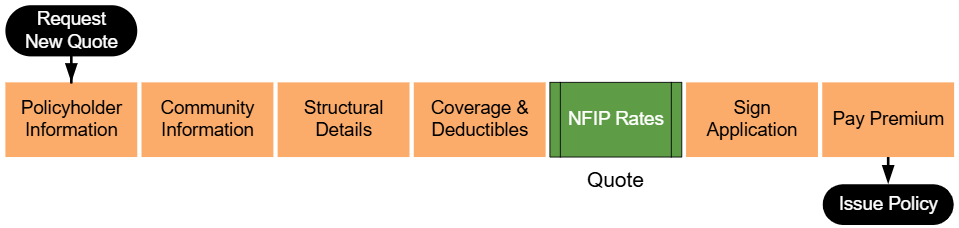
The workflow shown above begins by entering basic property details and continues through collecting additional information about the building, coverage options, and flood zone determinations. At the "NFIP Rates" step, highlighted in green, agents can generate a preliminary quote based on the details provided. This allows the agent to review potential costs before signing the application and collecting premium.
 Information Icons Information Icons
|
Equinox has small information icons placed next to important sections or fields. When a user hovers over an icon, a small window provides extra details about that section. The messages from these icons can be found in the collapsible sections below.
|
A. Request New Quote
Select the "Request New Quote" button near the top of the page.

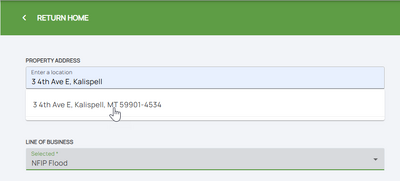
B. Property Address
Choose "NFIP Flood" from the second drop down window.
C. Step 1: Basic Information
From this point forward, the right side of the page will show a page completion list with the quote/application progress.
| Policy Effective Date
|
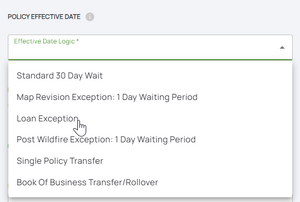
An NFIP flood policy has a 30-day waiting period provided the premium and the application are received within 10 days of the agent sign date, unless one of the following exceptions apply:
|
D. Step 2: Third Party Data
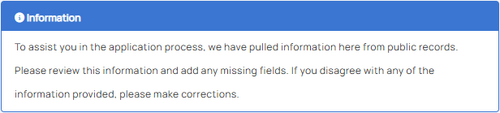
Agents should review all data for accuracy and manually input any missing or inaccurate information.
 Date of Construction Number of Floors
- A building with a basement and one floor above ground is rated as having one floor.
- An elevated building with an enclosure either compliant or non-compliant and one additional floor above it is rated as having one floor.
Square Footage- Garage area
- Basement or enclosure area
- Porches or decks
Building Replacement Cost Value Substantial Improvement Date- Improvements to correct code violations
- Alterations to historic buildings that preserve their designation
Construction Type- Frame: First floor above ground level is constructed with wood or metal frame walls.
- Masonry: First floor above ground level is constructed with masonry, including brick or concrete block walls for the full story.
- Other: Includes mixed materials or specific exceptions like knee walls.
NFIP Participating Community Information: This section shows NFIP community classifications and program details such as regular, emergency, non-participating, or suspended status.
Coastal Barriers and Protected Areas (CBRS/OPA): Yes/No fields determine if the property falls within Coastal Barriers Resource System (CBRS) or Otherwise Protected Areas (OPA). These options impact eligibility and policy requirements.E. Step 3: Property Information
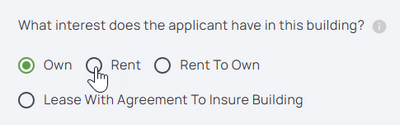
F. Step 4: Building Type
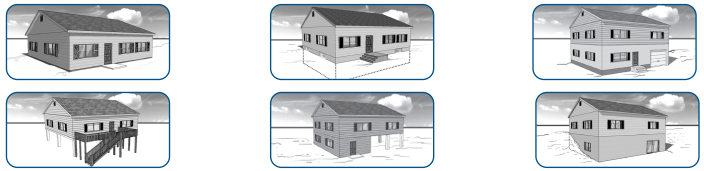
G. Step 5: Foundation Type
Agents must also answer a single question about the number of elevators in the building.
H. Step 6: Elevation Certificate Information
I. Step 7: Qualifying Questions
J. Step 8: Coverage, Deductibles & Discounts
K. Step 9: Rates
Next Steps
Once all steps are finished, the NFIP Application is complete.
The next step for Equinox to issue the policy would be to submit premium payment.