

Create NFIP Application: Difference between revisions
No edit summary |
No edit summary |
||
| Line 363: | Line 363: | ||
<tr> | <tr> | ||
<td>Is the building located over water?</td> | <td>Is the building located over water?</td> | ||
<td>Checks if the building is over water, which affects coverage eligibility. Find more information at [[NFIP Coverage Exceptions]].</td> | <td>Checks if the building is over water, which affects coverage eligibility. Find more information at [[NFIP Coverage Exceptions#Buildings Over Water|NFIP Coverage Exceptions]].</td> | ||
</tr> | </tr> | ||
<tr> | <tr> | ||
<td>Does at least 51% of the building’s actual cash value exist above ground?</td> | <td>Does at least 51% of the building’s actual cash value exist above ground?</td> | ||
<td>Ensures that most of the building’s value, including equipment, is above ground level for coverage. Find more information at [[NFIP Coverage Exceptions]].</td> | <td>Ensures that most of the building’s value, including equipment, is above ground level for coverage. Find more information at [[NFIP Coverage Exceptions#Buildings Below Ground|NFIP Coverage Exceptions]].</td> | ||
</tr> | </tr> | ||
<tr> | <tr> | ||
<td>Is the building designed to use Earth as insulation?</td> | <td>Is the building designed to use Earth as insulation?</td> | ||
<td>Determines if the building uses Earth-based insulation techniques, which may impact insurability. Find more information at [[NFIP Coverage Exceptions]].</td> | <td>Determines if the building uses Earth-based insulation techniques, which may impact insurability. Find more information at [[NFIP Coverage Exceptions#Buildings Below Ground|NFIP Coverage Exceptions]].</td> | ||
</tr> | </tr> | ||
</table> | </table> | ||
Revision as of 10:52, 12 December 2024



An agent must complete several steps to produce an NFIP application or obtain a quote. Equinox ensures that all required information is collected and validated before the application is submitted. This process is designed to reduce errors and enhance efficiency by guiding the agent through a series of steps that ensure compliance with NFIP guidelines.
|
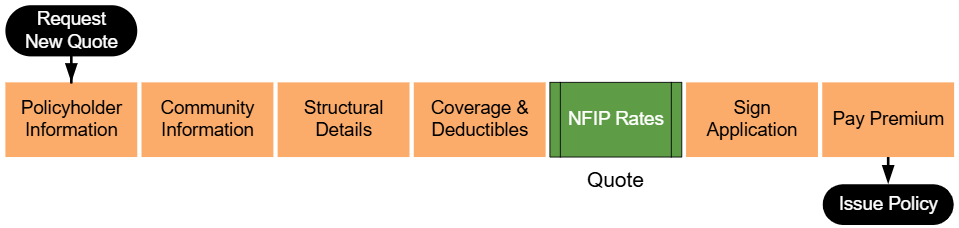
The workflow shown above begins by entering basic property details and continues through collecting additional information about the building, coverage options, and flood zone determinations. At the "NFIP Rates" step, highlighted in green, agents can generate a preliminary quote based on the details provided. This allows the agent to review potential costs before signing the application and collecting premium.
 Information Icons Information Icons
|
Equinox has small information icons placed next to important sections or fields. When a user hovers over an icon, a small window provides extra details about that section. The messages from these icons can be found in the collapsible sections below.
|
A. Request New Quote

B. Property Address
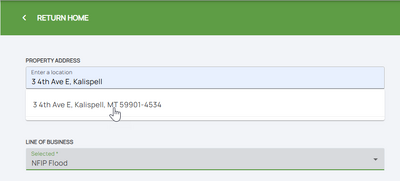
Choose "NFIP Flood" from the second drop down window.
C. Step 1: Basic Information
From this point forward, the right side of the page will show a page completion list with the quote/application progress.
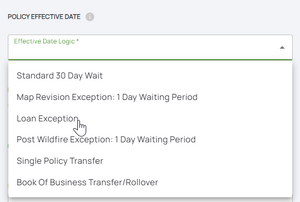
NFIP quotes are made in real time and rates are subject to change. All quotes must follow the NFIP waiting period rules assigned to new policies. For more information about each waiting period rule and how to calculate the application effective date, refer to the NFIP Effective Date Calculation.
NFIP Policy Effective Dates- Map Revision: A 1-day waiting period may apply if there's been a map provision and the property was previously in a B, C, X, or D zone and is now in an A1 through A30 or V1 through V30 zone. The rezoning must have occurred no more than 13 months prior to today's date.
- Loan Exception: If this policy is being purchased to meet a lender requirement for a new purchase, loan closing, or the increasing, extending, or renewing of a loan, the policy will go into effect at the time of closing provided the application and premium are received in a timely manner.
- Post-Wildfire Exception: A 1-day waiting period applies if the insured property is privately owned and post-wildfire conditions on federal lands caused or worsened the flooding. The insured must have purchased the new policy or additional coverage on or before the fire containment date or during the 60 days following the containment date.
D. Step 2: Third Party Data
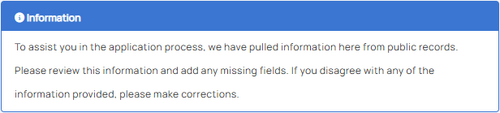
Agents should review all data for accuracy and manually input any missing or inaccurate information.
 Date of Construction Number of Floors
- A building with a basement and one floor above ground is rated as having one floor.
- An elevated building with an enclosure either compliant or non-compliant and one additional floor above it is rated as having one floor.
Square Footage- Garage area
- Basement or enclosure area
- Porches or decks
Building Replacement Cost Value Substantial Improvement Date- Improvements to correct code violations
- Alterations to historic buildings that preserve their designation
Construction Type- Frame: First floor above ground level is constructed with wood or metal frame walls.
- Masonry: First floor above ground level is constructed with masonry, including brick or concrete block walls for the full story.
- Other: Includes mixed materials or specific exceptions like knee walls.
NFIP Participating Community Information: This section shows NFIP community classifications and program details such as regular, emergency, non-participating, or suspended status.
Coastal Barriers and Protected Areas (CBRS/OPA): Yes/No fields determine if the property falls within Coastal Barriers Resource System (CBRS) or Otherwise Protected Areas (OPA). These options impact eligibility and policy requirements.E. Step 3: Property Information
- Determine if the building is Residential or Non-Residential.
- Selection impacts additional questions and policy options.
Detached Structures- Specify how many detached structures exist at the property address.
- The field defaults to "0" but can be adjusted using the arrow keys or by entering the number directly.
Determines the appropriate HFIAA Surcharge
- Primary Residence: $25
- Non-primary Residence: $250
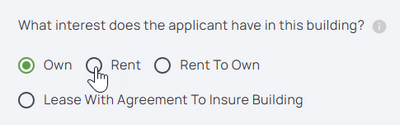
Applicant's Insurable InterestA property owner may ensure both building and contents on the same policy.
 Additions & Extensions
F. Step 4: Building Type
Single Family Dwelling Two to Four Family Dwelling Manufactured/Mobile Home or Travel Trailer Residential UnitMain Dwelling
A residential building that is the main dwelling on the property as opposed to any secondary dwelling such as a detached guest house.
Detached Guest House
A secondary house that shares the building lot for a larger primary house.
Description field to specify unique dwelling characteristics.
G. Step 5: Foundation Type
Agents must also answer a single question about the number of elevators in the building.
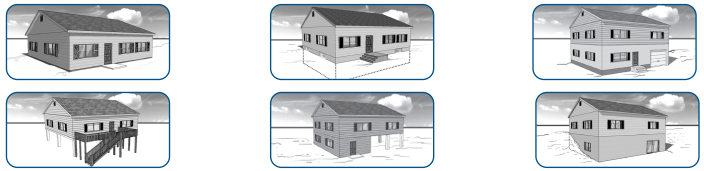
The Foundation Type step uses a series of radio buttons to help agents select the correct foundation type for the building. Clicking on a radio button displays images of foundation types, which can be clicked to finalize the selection. Agents must also answer a single question about the number of elevators in the building.
For detailed guidance, visit the NFIP Foundations page.
Elevated Buildings with Finished Areas Below Elevated Buildings with Enclosed Garages Below Flood Openings Requirements- For buildings with walls that are partially subgrade, there must be a minimum of two openings positioned on at least two exterior walls.
- For buildings with a single exterior wall at grade to the building (e.g., walkout basements), there must be a minimum of two openings positioned on the wall that is not below grade.
- The bottom of all openings must be no higher than one foot above the higher of the exterior or interior adjacent grade or floor immediately below the openings.
- Openings must have a total net area of not less than one square inch for every square foot of enclosed area.
H. Step 6: Elevation Certificate Information
This step collects information from an Elevation Certificate, a document typically completed by a licensed land surveyor but which may also be completed and submitted by the policyholder. For detailed guidance, visit the Elevation Certificate page.
Example: Diagram #2A applies to buildings with basements or split-level structures.
If the required diagram is not listed, consult the NFIP Foundations page for guidance on identifying the correct type.Section C: Enter elevation details for top/bottom floors, lowest/highest adjacent grades, and indicate the construction status (e.g., under construction, finished). Section E: Provide similar data for buildings without basements or enclosures, specifying measurements above or below adjacent grades.
Section H: Include information about machinery or equipment servicing the building, such as whether it is elevated above the first floor.I. Step 7: Qualifying Questions
| Topic | Explanation |
|---|---|
| Is the building affixed to a permanent site? | Ensures the building is permanently affixed to a specific location to qualify for flood insurance. Find more information at Building Eligibility. |
| Does the building have two or more outside rigid walls and a fully secured roof? | Verifies that the building meets minimum construction standards for coverage eligibility. This requirement is waived if the building is under construction. |
| Does the building resist flotation, collapse, and lateral movement? | Confirms the building is designed to withstand flood-related forces like buoyancy or erosion. Find more information at Building Eligibility. |
| Is the building located over water? | Checks if the building is over water, which affects coverage eligibility. Find more information at NFIP Coverage Exceptions. |
| Does at least 51% of the building’s actual cash value exist above ground? | Ensures that most of the building’s value, including equipment, is above ground level for coverage. Find more information at NFIP Coverage Exceptions. |
| Is the building designed to use Earth as insulation? | Determines if the building uses Earth-based insulation techniques, which may impact insurability. Find more information at NFIP Coverage Exceptions. |
J. Step 8: Coverage, Deductibles & Discounts
Discount Eligibility
Agents must answer questions to determine eligibility for specific NFIP discounts, such as:
- Prior policy status, including lapses for Newly Mapped or Pre-FIRM discounts.
- The elevation of essential equipment, such as air conditioners, water heaters, and elevator machinery, above the first-floor elevation.
K. Step 9: Rates
Agents must:
- Review the itemized premium amounts and verify accuracy.
- Enter any of the additional details:
- Insured mailing address
- Additional insureds
- Mortgagee information
- Agent of record
- Provide any additional relevant details in the text box for supplementary information.
- Electronically sign the document.
Next Steps
Once all steps are finished, the NFIP Application is complete.
The next step for Equinox to issue the policy would be to submit premium payment.